


As the AI boom grows worldwide, state Representative Joey Andrews is seeking to prepare Southwest Michigan residents for what large scale data centers could mean for the region.
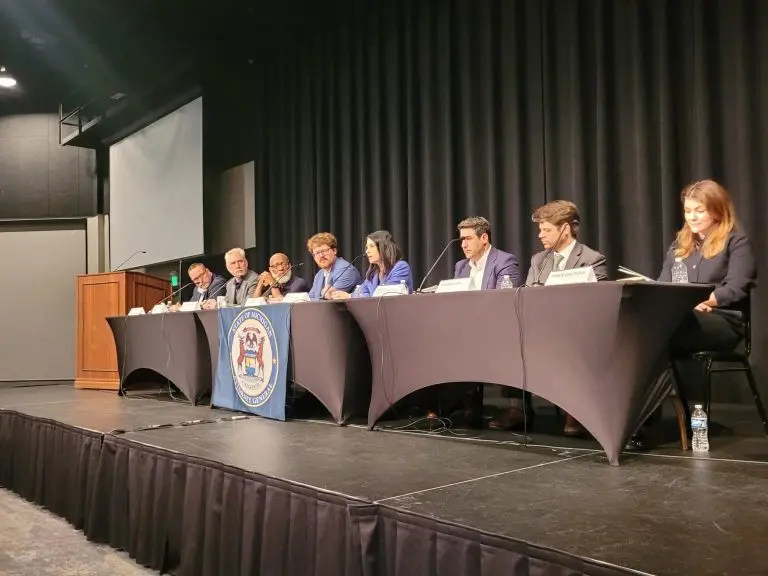
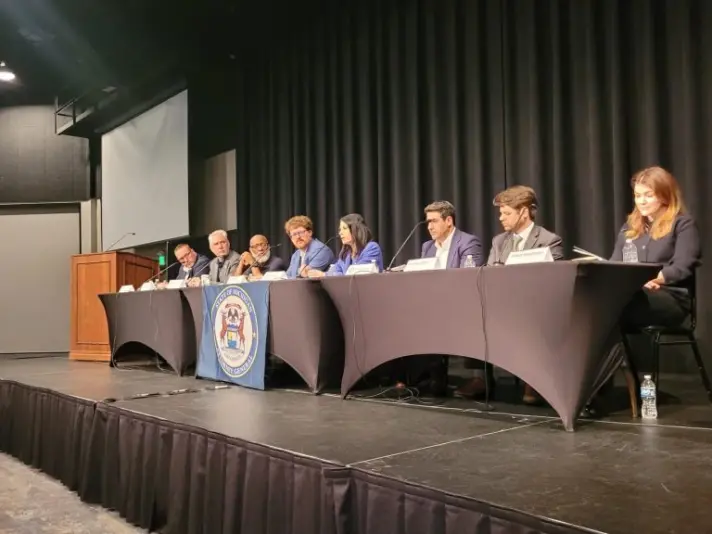
Andrews led a town hall meeting Thursday night in Benton Township to discuss the implications of data centers coming to the state with panel of experts including Michigan Attorney General Dana Nessel and a representative of Google.
Nessel stressed that the state needs guardrails in the form of laws and contracts to prevent electric ratepayers and taxpayers from footing the bill for the massive amounts of power and water the centers use. She also said agreements should be in place with tech companies to ensure they’ll remediate data center sites if the centers become obsolete or the AI bubble bursts.
Nessel said now is the time for Michigan to position itself to benefit from the centers.
“But if we don’t make our voices heard now, the opportunity to welcome the industry to our state responsibly will pass us by and we’ll be forced to live with the consequences of bad contracts, rushed deals, and cut corners for decades and decades to come,” Nessel said.
Nessel called for transparent contracts between tech companies and the Michigan Public Service Commission, saying, “I don’t think we should just take these companies at their word.”
“These AI companies have been making a lot of promises to sell local communities on the idea of building a new data center in their backyard. And they do promise a lot of jobs, but most of them occur in the construction phases. Then, afterwards, specialized positions can work virtually from anywhere in the world, meaning that there is little long-term benefit to local employment rates that we’ve seen.”
Meanwhile, Google’s Grace Walovich said the company always strives to ensure it pays for all power it consumes and invests in energy efficiency. Google is currently working on a data center in Van Buren Township, in Wayne County.
“We are incredibly excited about the opportunity to plant deeper roots in Michigan,” Walovich said. “We are committed to paying our way and bringing clean energy solutions to the state that will directly support the larger state climate goals. And again, our approach to data center development is rooted in responsibility. We don’t just build facilities, we want to be part of the community fabric and find ways to engage with the local communities.”
Jason Piontek with the International Brotherhood of Electrical Workers 153, representing workers in Berrien and Cass counties as well as parts of Indiana, said data center projects have meant big business for the skilled trades.
“For the past 14 to 16 months, we have been working on the AWS Data Campus in New Carlisle,” Piontek said. “That data campus has approximately about 1,950 electricians and technicians working for about 13 traveling contractors.”
Walovich talked about some of the jobs created by Google data centers.
“These structures, our infrastructure particularly, when they are fully up and operational, it’s several hundred jobs, and it’s a combination of both tech and non-tech,” Walovich said. “So I think about it as technical folks that are walking the halls of the data center, making sure that the guts of all of the computers and the chips are working so we can do a Google search or place our Domino’s order, whatever it may be. And it’s also non-tech.”
Representative Andrews compared the data center boom to the railroad boom that once spread across the United States, saying this is the new industrial revolution. Nessel questioned the benefits of state tax breaks for data centers, proposing an example of a $90 million break for a center that provides 30 jobs, but Andrews said the simple reality is that the tax breaks attract development and no one loses anything by having them.
“Yes, we’re giving them a 6% sales and use tax break, but as I stated earlier, you don’t get these projects without those,” Andrews said. “So it’s basically not losing anything because it was nothing you were ever going to get, right? You were never going to get the $90 million from the company because the company was never going to be here without the tax break.”
Andrews said data centers are booming now, and Michigan can’t miss out on its one shot to benefit, stressing the enormous affect the centers could have on local governments and schools by expanding the tax base.
“What does that do to the community? Well, in our case, let’s say, using local areas as an example, you’d be doubling budgets of local school systems, your local townships. That means the township in the capital of Virginia cut property taxes for local residents because they now have a huge commercial property, industrial property tax payer. Our community college would stand to gain millions of dollars, our county government would gain millions of dollars.”
Andrews told us later with so much misinformation now circulating about data centers, he organized the meeting to let residents hear the facts for themselves. He also said during Thursday’s meeting he’s all for approving guardrails, like the ones Nessel was talking about, to protect Michigan residents. However, he was less optimistic the Michigan House Speaker would cooperate.
The town hall included no announcement about a data center coming to Southwest Michigan. Andrews said he’s aware of no such project in the works.